
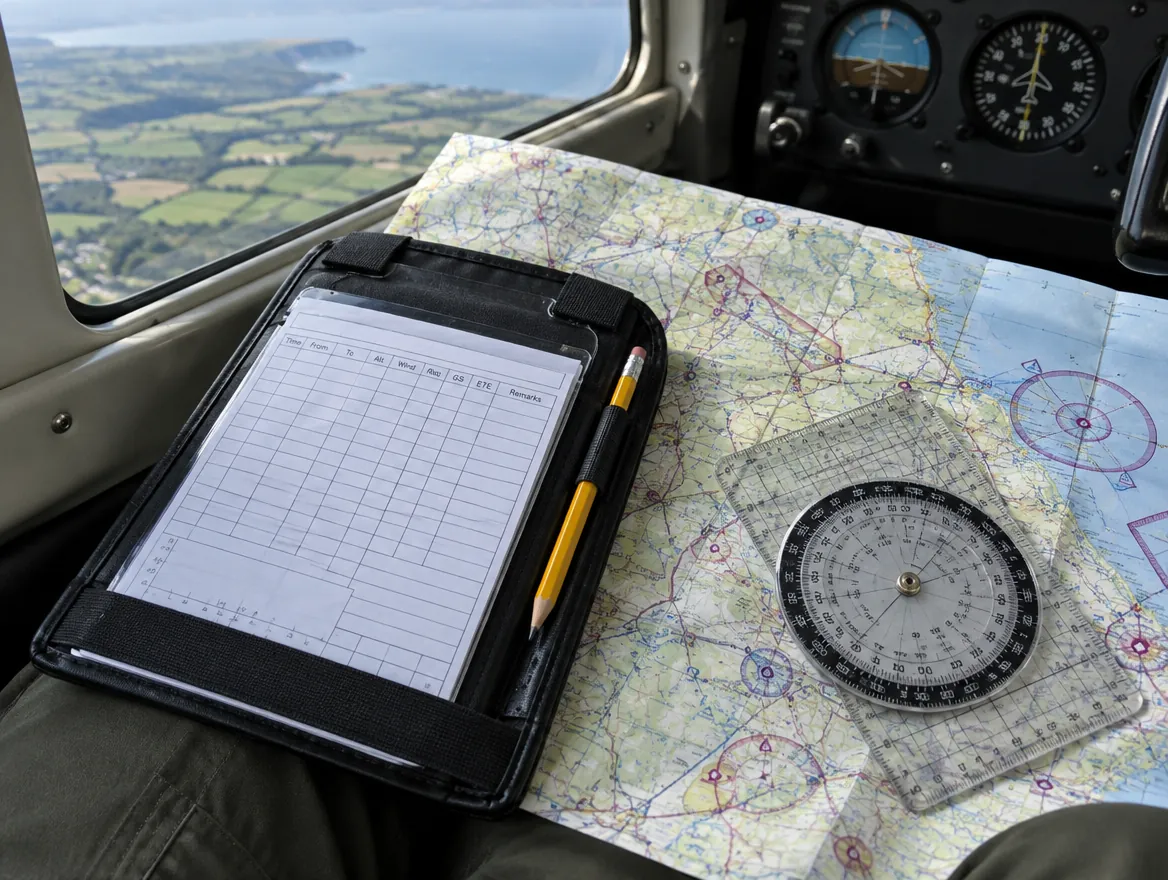

 Our own colour flight log · version 4.0
Navigation Flight Log
Developed from over 35 years of experience, with human performance, airspace infringements, radio, best practice and up-to-date legislation in mind. We're confident it's the best on the market.
- 50
- tear-off A5 pages a pad
- UK
- postage included
Why another flight log?
Navigation is a hot topic
There's a big choice of navigation flight logs in all shapes and sizes; you may even have made your own. But with airspace infringements and poor radio communication continuing, there's renewed emphasis on how navigation is taught and done.
Ours has stood the test of time, tweaked and refined over the years to the point where we're confident it's the best there is.
Helps prevent infringements
Minimum, navigation and maximum altitudes for every leg.Prompts correct planning
And keeps the calculations apart from the heading to fly.Easier fuel management
A fuel plan, and endurance by time remaining.Organised clearances
In time order, with radio and emergency prompts.Colour coded
The only flight log in colour, at no extra cost.Air Ops Part-NCO ready
Meets the journey log requirements.Fewer in-flight errors
A layout designed around how you actually fly.Made for teaching
Every element an instructor needs to teach.
Features explained
Every box has a reason
- 1
Supports standard and narrow A5 kneeboards
You only write in flight on the right-hand side, so the left can overhang the kneeboard without getting in the way. The Info & Clearances section can be folded under, permanently, or to show a clean Info & Clearances column beneath, keeping the original flight log data.
- 2
Prompts for minimum, navigation and maximum altitudes on every leg
No other navigation log prompts for, and makes space for, three altitudes or levels while you plan. This best-practice approach keeps the flight between the levels you've chosen, avoiding vertical airspace busts. How to choose the best minimum altitude is in our Best Navigation Practices course.
- 3
Navigation calculations kept apart from the in-flight log
Other logs put the calculations on the same line as the heading to fly, which can lead to the simple human error of flying the wrong figure. Keeping the calculations separate makes that error impossible.
- 4
Reminders of the often-ignored references
So an instructor can teach every aspect, the log prompts for the calculations and references others ignore: true airspeed (TAS), freezing level, sunset, deviation and set course time.
- 5
A pro-forma fuel plan, and fuel managed by time remaining
Fuel planning is vital, now a legal requirement even for private flights (Air Operations Part-NCO), yet most logs give too little guidance. The Fuel Plan section prompts for correct planning, and the Fuel Management section gives your endurance directly, without further calculation.
- 6
Emergency, transponder and radio prompts
Reminders of what goes in initial and later radio calls and position reports, the Mayday and Pan content, and the transponder codes to use.
- 7
Space for communication and navigation frequencies
Plenty of room at the planning stage for the communication and navigation aid frequencies you'll need.
- 8
In-flight information and clearances in time order
The Info & Clearances column makes you write in order, so you don't pick out old pressure settings, squawks or clearances by mistake. On the right of the log, it folds beneath the page to show a fresh column on the next sheet as a continuation.
- 9
Colour coding to separate the sections
Colour helps compartmentalise the log for planning and in flight: section separators in yellow, references and reminders in grey, the heading to fly in blue, and diversion planning in pink. Ours is the only flight log to use colour, at no extra cost.
- 10
Meets the journey log requirements of Part-NCO
Part-NCO sets out what a journey log must contain, and this navigation log is designed to include all of it.
More on choosing your minimum altitude, and on planning to current best practice, in our Best Navigation Practices course.
User guide
How to use your flight log
We strongly recommend our Best Navigation Practices course too, so your pre-flight planning follows current best practice.
- 1
Write the legs you'll fly in the NAVIGATION FLIGHT PLAN: distance (DIS), minimum altitude (MIN), the navigation altitude you'll fly (NAV), and the maximum altitude before infringing controlled airspace (MAX).
- 2
Write the indicated airspeed (IAS) and temperature (°C) for the NAV altitude, to work out the pressure altitude (PRESS ALT) and true airspeed (TAS).
- 3
Write the freezing level (0°C FL) and sunset time (SS).
- 4
Write the true track (TR T) for each leg in the NAVIGATION CALCULATION section. It's split into two columns of 7 boxes for the 6 legs of the flight plan; the pink boxes are for the diversion leg.
- 5
Complete the NAVIGATION CALCULATIONS using the wind velocity (W/V) to give the true heading (HDG T). Apply magnetic variation (V) for the magnetic heading (HDG M), and compass deviation (D) for the compass heading (HDG C). Enter the ground speed you work out in each leg's GS box in the flight plan, and the maximum drift in MAX DRIFT.
- 6
Copy the compass headings (HDG C) to the blue HDG C boxes in the NAVIGATION FLIGHT PLAN (the diversion's is pink).
- 7
In the NAVIGATION FLIGHT PLAN, work out the TIME for each leg from its distance (DIS) and ground speed (GS).
- 8
Complete the FUEL PLAN from fuel flow (Flow), route time (Route), contingency (5%), diversion (Divert) and reserve (Res): Part-NCO suggests a 30-minute reserve by day and 45 minutes by night for private flights. Allow for departure, climb, descent and arrival fuel (Dep/Climb/Desc/Arr), typically 15 minutes at cruise consumption. Work out the Total Required and the amount On Board; the grey arrows show which way the sums go.
- 9
From the fuel On Board, fill in the FUEL MANAGEMENT Time Remain Left/Right Tank boxes with the endurance each tank gives.
- 10
Write the communication and navigation frequencies in their section. The R/T section reminds you how calls are made (initial call content in bold), and the RADIO section, top left, reminds you of emergency calls and what goes in a Mayday.
- 11
In flight, fill in Brakes Off and Set Course in FLIGHT INFORMATION, and the first leg's estimated time of arrival (ETA). At the end of the leg, write the actual time of arrival (ATA) and the next leg's ETA.
- 12
Manage fuel by time. After 30 minutes, change tanks and reduce that tank's Time Remain by 30 minutes (for example, cross out 02:00 and write 01:30). Your endurance is the two Time Remain figures added together.
- 13
At the end of the flight, fill in Brakes On.
Reminders on the log
Help when you need it most
- RADIO: the distress frequency, 121.5, and what goes in a distress call.
- TRANSPONDER: the emergency transponder codes.
The Mayday call
- SThe station you're addressing
- CYour callsign
- TYour aircraft type
- EThe emergency (e.g. “Engine failure”)
- AThe action you're taking (e.g. “Forced landing in a field”)
- PYour position
- AYour altitude
- HYour heading
- QYour qualifications (e.g. “Student pilot” or “PPL”)
- IAny other useful information (e.g. “Two persons on board”)
Buy Navigation Flight Logs
Order your pad
50 tear-off A5 pages, with postage within the UK included. Any extra postage charges are paid by you directly to the courier on receipt.
Don't know where to start?
Let us help you!
Your short-cut to becoming a pilot.